

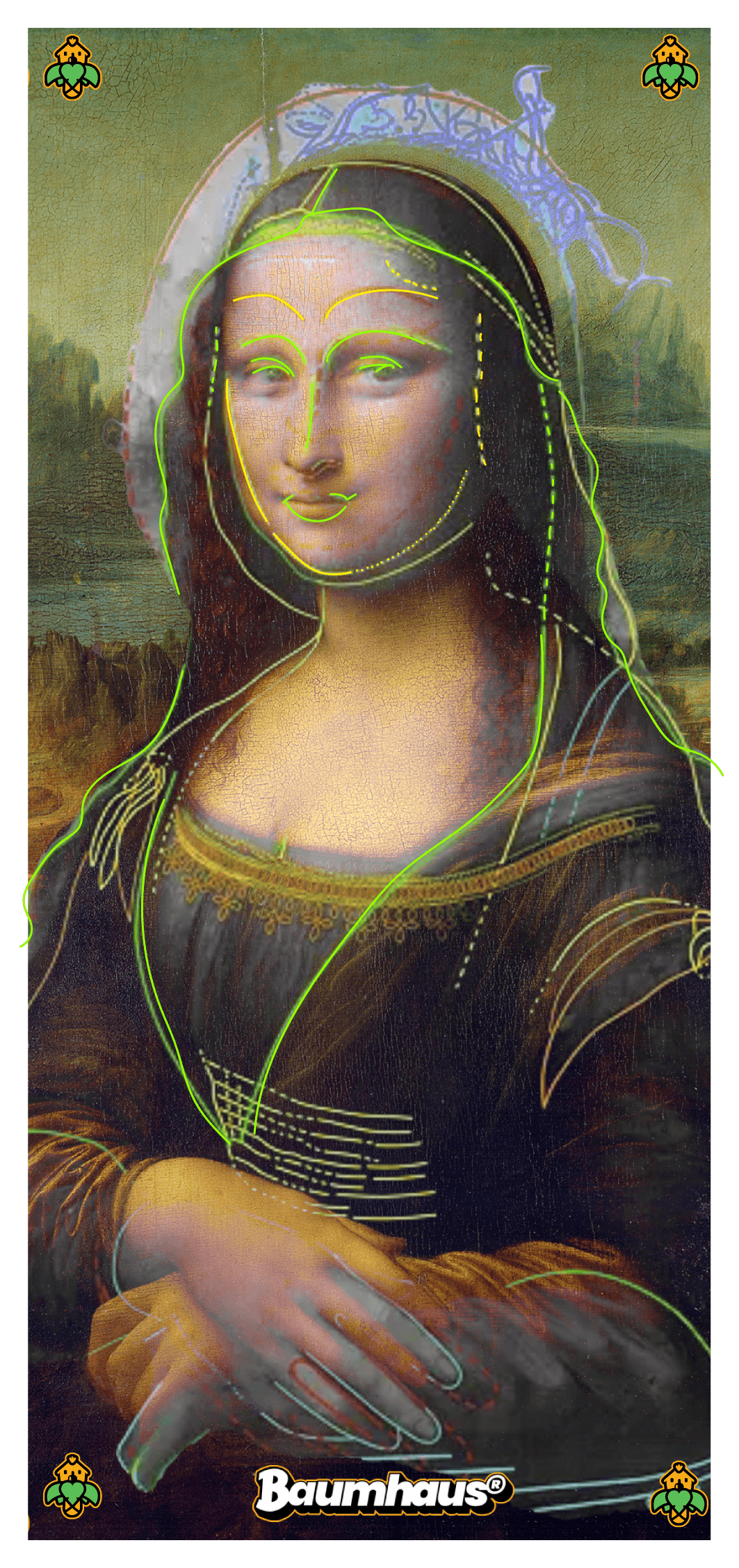
The Mona Lisa’s Dark Secret.
The Mona Lisa’s Dark Secret. Over the past 500 years the Mona Lisa has lived quite a life. She lived with Leonardo da Vinci for 16 years. She called the palace of Versaille home (she had to move to the Louvre after the French Revolution). She has been kid napped. She has locked eyes with more people than anyone in history.
If only she could talk.
Our understanding of art was rocked to the core when one of her secrets was revealed. We discovered:
The Mona Lisa…. was traced.
And nobody cared.
The Discovery The Louvre requested a detailed scan of Leonardo’s masterwork. Pascal Cotte and the team at Lumiere Technology carried out the scan using a multi-spectral camera.
It revealed an under drawing that had been hidden for 500 years.
Tricks of the Trade This tracing technique is called pouncing or spolvero.
It is done by poking a drawing with small holes and dusting it with charcoal.
The charcoal falls through the holes and imprints a ‘cartoon’ on the canvas below. A tried and true method of reproduction.
Among the techniques employed by the master, Leonardo also pioneered a technique known as sfumato. This technique of applying the pigment in thin, translucent layers made for a atmospheric effect and soft edges.
Walter Isaacson’s article for The Atlantic goes into wonderful detail regarding the creative process and how art and science were joined in this great work.
The multi-spectral imaging used to make the discovery is nearly as layered as the painting (The Mona Lisa has more than 30 layers of paint, applied over 16 years in thin layers).
The camera was originally developed for use in satellite imaging. It captures U.V, infrared and visible light.
Thirteen filters are applied to the sensor, resulting in thirteen distinct images. Each images depicts a specific band of the light spectrum.
The layers are amplified during post processing to get more information.
This video goes into some more detail on the scanning process.
This video by Great Art Explained will take you on a journey of the Mona Lisa.
Why Does This Matter to You You might imagine art being the product of a magical stroke of the brush by a lone genius.
You might not realize that fine art is the result of craftmanship.
You might be holding on to a false belief;
That you yourself are not an artist.
The scan reveals a truth embedded deep in the most famous painting in the world; Fine art is a result of craftsmanship.
Its easy as ABC:
Art Because Craft. Pouncing was used to get the under drawing right. A trick of the trade, a technique, a tool. And for good reason.
It would be senseless to spend sixteen years building a house on a bad foundation. Painting on a bad under drawing is no different.
This was a sketch found in Leonardo’s notebooks, among other anatomical sketches of the mouth.
It took learning, iteration and scientific discovery to bring this sketch to life.
Leonardo dissected the faces of corpses to gain a better understanding of the inner workings of the smile. He wrote extensively about the muscles of the cheek and lips; how they give shape to our expressions and emotions.
This is an art work. It took took a lifetime of learning and 16 years of work. That is dedication.
The layers of the painting were built up over time. Some 30 layers, painted so finely, they total half a human hair in thickness.
There are folks who say the work unfinished, since Leonardo lost use of his arm near the end of his life. This would be one of many unfinished works once started by da Vinci.
The Mona Lisa has gone through a great deal herself.
She had eyebrows once, then lost them.
The sky used to be blue. The varnish used on the painting has turned to a greenish grey over time.
The painting was considered to be a great work among many great works of the renaissance.
The painting was taken from the Versaille to the Louvre after the French Revolution. Stolen in the ’60s. Picasso was implicated in the heist, but it turned out to be Vincenzo Purugia, an Italian patriot who worked at the Louvre. He was trying to return the work to Italy.
There is a reason why people go to visit this work where she lives:
Because of the story. The history. The discoveries made during her creation and her own lifetime.
Is Tracing Cheating? I guess it all depends.
If you are just starting out, learning to draw in perspective is a skill to develop.
You may not develop this skill if you only trace when first starting out.
Leonardo went through his apprenticeship and learned his craft well. Considering how long he spent on the painting, tracing the under drawing was understandable.
The Modern Artist with a Unique Perspective. Kim Jung Gi is an artist, like da Vinci, who shows us what we are capable through practice and dedication.
He draws massive, sprawling scenes, using only his imagination.
He has said that observation, practice and learning is how he developed his skill of drawing.
He develops his eye and is drawing all the time. Not unlike Leonardo, who would spend hours observing anything and everything.
He imagines grids and perspective while he draws. Its possible. He learned to do it. Learning and practice.
Bringing it Home. Maybe in elementary school tracing is considered cheating. That is a good time to learn perspective. Build up an understanding of the fundamentals. Which is ironic, I lacked the patience then when it would’ve made the biggest difference to my understanding of drawing.
Art is something that we can all do. Also its worth recognizing that which we do every day can be elevated to art. What we do with love is art. That is how I see it.